Back to blogs Tennis court guide
Tennis court guidePickleball vs tennis: every difference that matters
Pickleball and tennis look like cousins, and they are, but they play almost nothing alike. Tennis is a big, fast, athletic game built on power and court coverage. Pickleball is smaller, slower off the bounce, and far more social, with most of the action packed into a few feet on either side of the net. If you can play one you can pick up the other in an afternoon, but the feel, the gear, and the scoring are genuinely different. Here is every real difference between pickleball and tennis that actually matters.
What is pickleball?
Pickleball was invented in 1965 on Bainbridge Island, Washington, by three dads improvising a backyard game for bored kids. They set up on a badminton court, borrowed the paddle from table tennis and the underhand serve and soft net play from badminton, used a perforated plastic ball, and adapted the net and scoring as the rules took shape. The result is a paddle sport played on a court about a third the footprint of a tennis court. It is now the fastest-growing sport in the United States, mostly because it is easy to start and easy on the body.
- Court size
- Pickleball 44 x 20 ft / Tennis 78 x 36 ft (doubles)
- Net height, center
- Pickleball 34 in / Tennis 36 in
- Ball
- Pickleball perforated plastic / Tennis pressurized felt
- Hitting tool
- Pickleball solid paddle / Tennis strung racket
- Serve
- Pickleball underhand, below the navel / Tennis overhand
- Scoring
- Pickleball first to 11, win by 2 / Tennis games, sets, deuce
- Invented
- Pickleball 1965 / Lawn tennis 1870s
The court and the net
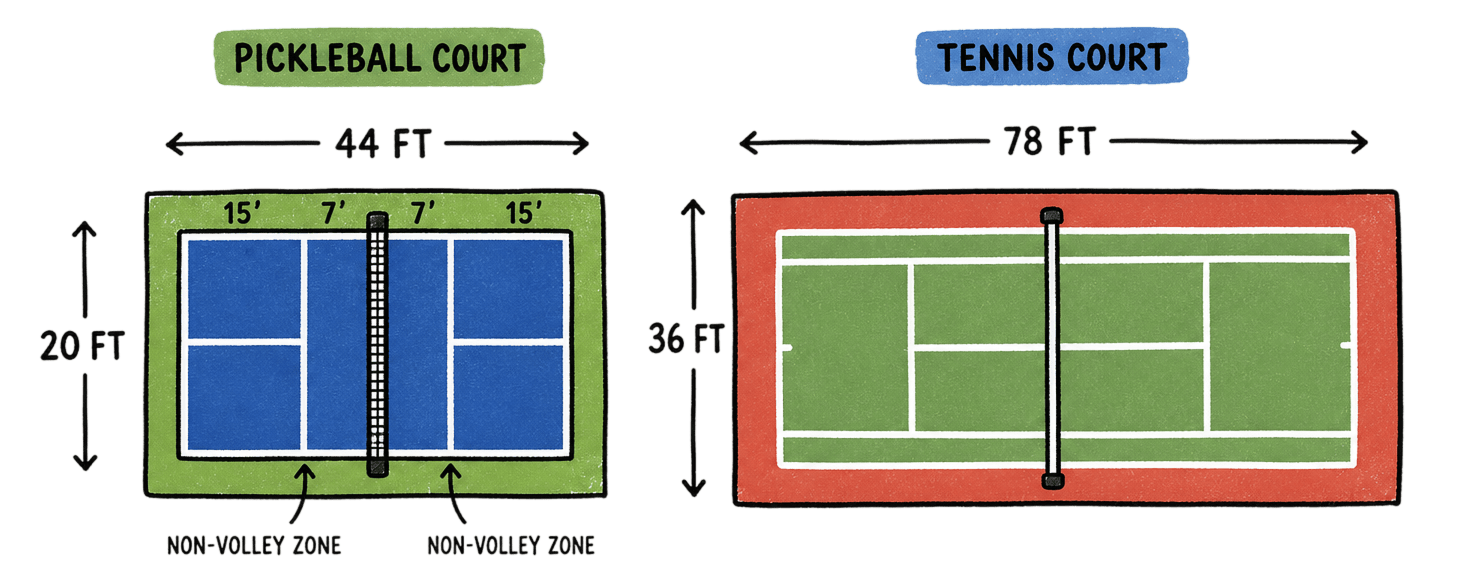
A pickleball court is 44 by 20 feet; a tennis court is 78 by 36 for doubles. That size gap is the single biggest difference, and it cascades into everything else: less ground to cover, shorter points, and far less running. You can stripe up to four pickleball courts onto one tennis court, though three with proper run-off space is the practical number. The net is close but not identical, 34 inches at the center for pickleball versus 36 for tennis, a two-inch drop that matters more than it sounds when you share a court. For the exact figures, see how big is a tennis court and pickleball court vs tennis court dimensions.
The gear: paddle and plastic ball
Tennis uses a strung racket and a pressurized felt ball that bounces high, moves fast, and takes heavy spin. Pickleball uses a solid paddle, no strings, and a hard perforated plastic ball that bounces low, travels slower, and barely holds spin. That one swap changes the entire rhythm: tennis rewards big swings and topspin; pickleball rewards touch, placement, and quick hands. The plastic ball is also far more affected by wind, which is why outdoor and indoor pickleballs are different.
How you serve and score
In tennis you serve overhand, and a big serve is a weapon that can end points outright. In pickleball the serve is underhand and struck below the navel, with the paddle head below the wrist, so it just starts the rally rather than winning it. Scoring differs just as much. Tennis runs on 15-30-40, games, and sets, with deuce and tiebreaks. Pickleball is simpler on paper: first to 11, win by 2, and in traditional play you can only score on your own serve, so the server calls the score before every point.
The kitchen and the two-bounce rule
Two rules give pickleball its distinct shape and have no equivalent in tennis. The first is the non-volley zone, universally called the kitchen, a seven-foot strip on each side of the net where you cannot hit the ball out of the air. It exists to stop players from camping at the net and smashing everything. The second is the two-bounce rule: the serve must bounce once, and the return must bounce once, before either side can volley. Together they slow the start of every point and turn the net into a patient game of soft 'dinks', the opposite of tennis serve-and-volley.
Which is harder, and which is easier to learn?
Pickleball has the gentler learning curve. The court is small, the serve is simple, the ball is slow, and you can rally on day one, which is exactly why it draws players of every age and fitness level and is kinder to knees, shoulders, and backs. The difference is concrete on the court: a tennis player defends a half-court nearly 39 feet deep, while a pickleball player covers about 22 feet to the baseline, so there is far less ground to lose and far less sprinting. Tennis asks more of you up front: more running, a harder serve to groove, more technique in every stroke, and a bigger court to defend. It takes longer to feel competent, but the ceiling is higher and the workout is bigger.
So which should you play?
It is not either/or, and plenty of people play both. Choose pickleball if you want a quick, social, low-impact game you can be decent at fast. Choose tennis if you want a bigger athletic challenge and the classic sport. The good news is that a growing number of facilities now stripe their courts for both, so you rarely have to choose a venue, only a game for the day.
Whichever you pick, the real bottleneck is the same: finding a court and someone to hit with at your level. Doyouplay shows tennis courts near you, many of which now host pickleball too, and the players who use them, so you can line up a partner who actually shows up. If you want to share a single court, here is how to set up pickleball on a tennis court.