Back to blogs Tennis court guide
Tennis court guidePickleball court vs tennis court: dimensions, lines, and net
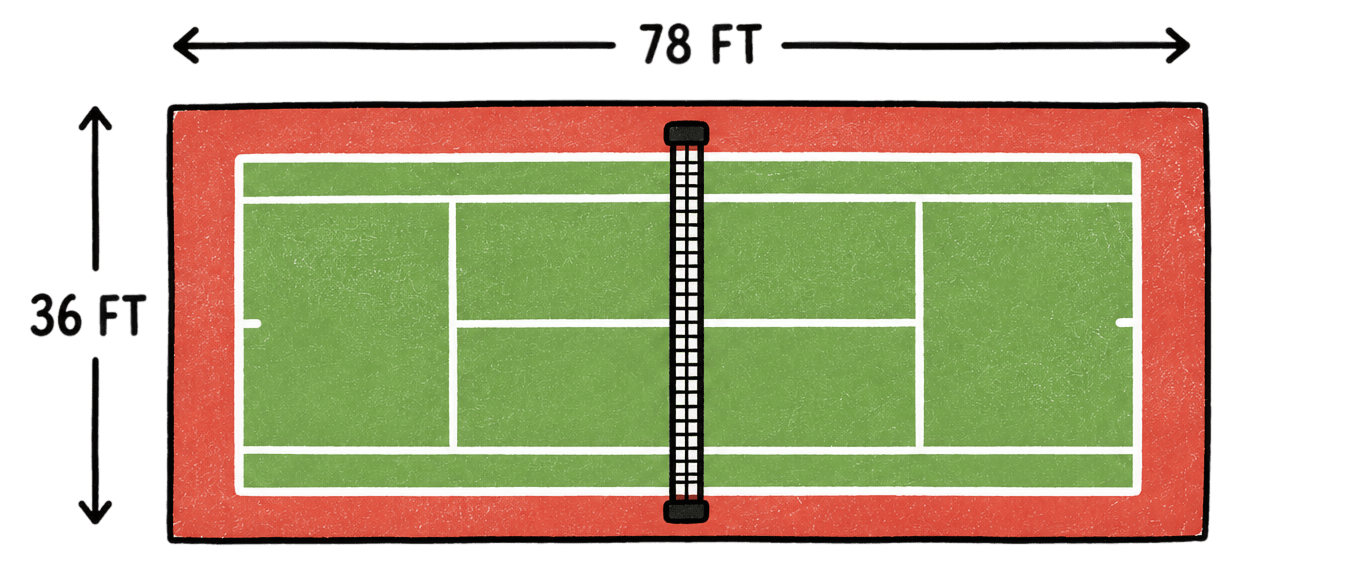
A pickleball court is 44 by 20 feet. A tennis court is 78 by 36 feet for doubles. So a pickleball court is about a third the footprint of a tennis court, the net sits two inches lower, and the lines tell a different story. Here are both courts side by side, what each line means, and the small net difference that trips people up on shared courts.
- Length
- Pickleball 44 ft / Tennis 78 ft
- Width
- Pickleball 20 ft / Tennis 36 ft doubles, 27 ft singles
- Playing area
- Pickleball 880 sq ft / Tennis 2,808 sq ft (doubles)
- Net height, center
- Pickleball 34 in / Tennis 36 in
- Net height, posts
- Pickleball 36 in / Tennis 42 in
- Baseline to net
- Pickleball 22 ft / Tennis 39 ft
- Singles vs doubles
- Pickleball same court / Tennis adds the doubles alleys
In pickleball, that same 44 by 20 ft court is used for both singles and doubles. In tennis, singles narrows the court to 27 ft wide by taking the doubles alleys out of play; the length and net never change.
Pickleball court dimensions
A pickleball court is the same size for singles and doubles, which keeps things simple:
- Overall: 44 ft long by 20 ft wide (the same as a doubles badminton court).
- Non-volley zone (the kitchen): a 7 ft strip on each side of the net where you cannot volley.
- Service areas: each is 15 ft deep by 10 ft wide, split left and right by a centerline.
- Baseline: 22 ft from the net on each side.
- Net: 34 inches at the center, 36 inches at the posts.
- Run-off: USA Pickleball sets a 30 ft by 60 ft minimum total space, with 34 ft by 64 ft preferred for new courts, so players have room behind and beside the lines.
Tennis court dimensions
A tennis court packs two games into one set of lines, singles and doubles, which is why it has more markings:
- Overall: 78 ft long by 36 ft wide for doubles; the court narrows to 27 ft for singles.
- Doubles alleys: a 4.5 ft lane down each side, in for doubles and out for singles.
- Service boxes: each is 21 ft deep by 13.5 ft wide.
- Net: 36 inches at the center, 42 inches at the posts.
- Baseline: 39 ft from the net on each side.
For the deeper story on those numbers, the 1877 origin, and what the side lines mean, see how big is a tennis court.
Putting them side by side
The pickleball court is dramatically smaller in every direction: 34 feet shorter and 16 feet narrower than a doubles tennis court. By area it is roughly a third the size, which is why you can stripe up to four pickleball courts onto a single tennis court, though three with proper run-off space is the practical number. There is no doubles alley in pickleball, the court is one fixed width, and there is no kitchen in tennis, the non-volley zone is unique to pickleball.
The lines, and why a shared court looks busy
Each game has its own line set. Pickleball has sidelines, a baseline, a centerline, and the kitchen line, no alleys. Tennis has singles and doubles sidelines (the alleys), a baseline, two service lines, and a center service line, no kitchen. When a facility paints both games onto one court, you get a dual-striped court: all of those lines overlap, usually in two colors, which looks chaotic at first but lets the same court host either sport.
The net difference that matters
Two inches sounds trivial, but it is the thing to plan for. A pickleball net is 34 inches at the center; a tennis net is 36. If you play pickleball using the existing tennis net, it sits about two inches high in the middle, which favors the defense and makes drives clip the tape. Tightening the tennis net's center strap to pull the middle down helps; a portable pickleball net solves it cleanly. If you are setting up on a tennis court, our guide on playing pickleball on a tennis court covers the net, lines, and etiquette.
Once you know the footprint, the next question is where to play. Find tennis courts near you, many now dual-striped for pickleball, and line up someone to play with. New to the differences beyond the court itself? Read pickleball vs tennis: every difference that matters.